10 HARO pitch examples and response templates for 2026, with a 100-point quality scorecard, length guidance, AI-response rules and practical outreach examples.
HARO outreach guide · Updated August 12, 2026
Quick answer: what should a HARO pitch look like?
A strong HARO pitch normally does five things quickly: it proves the source is eligible, answers the journalist’s exact question, gives one specific or experience-backed detail, provides a sentence that is easy to quote, and follows every instruction in the request. The best HARO response template is therefore a framework, not a script: credential → direct answer → evidence/example → clean attribution.
If you want help drafting a first version, use our free HARO and journalist pitch generator, then fact-check and rewrite the result in the expert’s real voice before sending.
HARO is active again in 2026
Some older guides still describe HARO as shut down or permanently replaced by Connectively. That is outdated. HARO is active in 2026 as a free journalist-request newsletter and currently sends Morning, Afternoon and Evening editions. Connectively exists as a platform-style sister product, while Featured operates as a broader PR workflow product.
That matters for pitch writing because source requests are still deadline-driven. If you are building a repeatable workflow, pair this guide with our journalist response-time framework and our Qwoted vs Featured vs HARO comparison.
The HARO response template we recommend
Subject: [Short topic] — [Expert name], [relevant role]
Hi [Journalist name],
[One-sentence credential fit.]
[Direct answer to the exact question.] [Two to four sentences explaining why, with one concrete example, operating detail, data point you can verify, or first-hand observation.]
[Optional second answer if the query contains another question.]
Attribution: [Name], [Title], [Company]
[Website or press-page link only if requested or genuinely useful.]
Best,
[Name]
This is intentionally simple. Journalists do not need a long company introduction before they reach the usable answer. Our broader journalist pitch-writing guide explains how to make individual sentences easier to quote and edit.
HARO pitch quality scorecard: 100-point framework
The chart below is an Editorial Backlinks review framework, not an official HARO score and not a measured placement-probability model. It is designed to make pre-send quality control consistent.
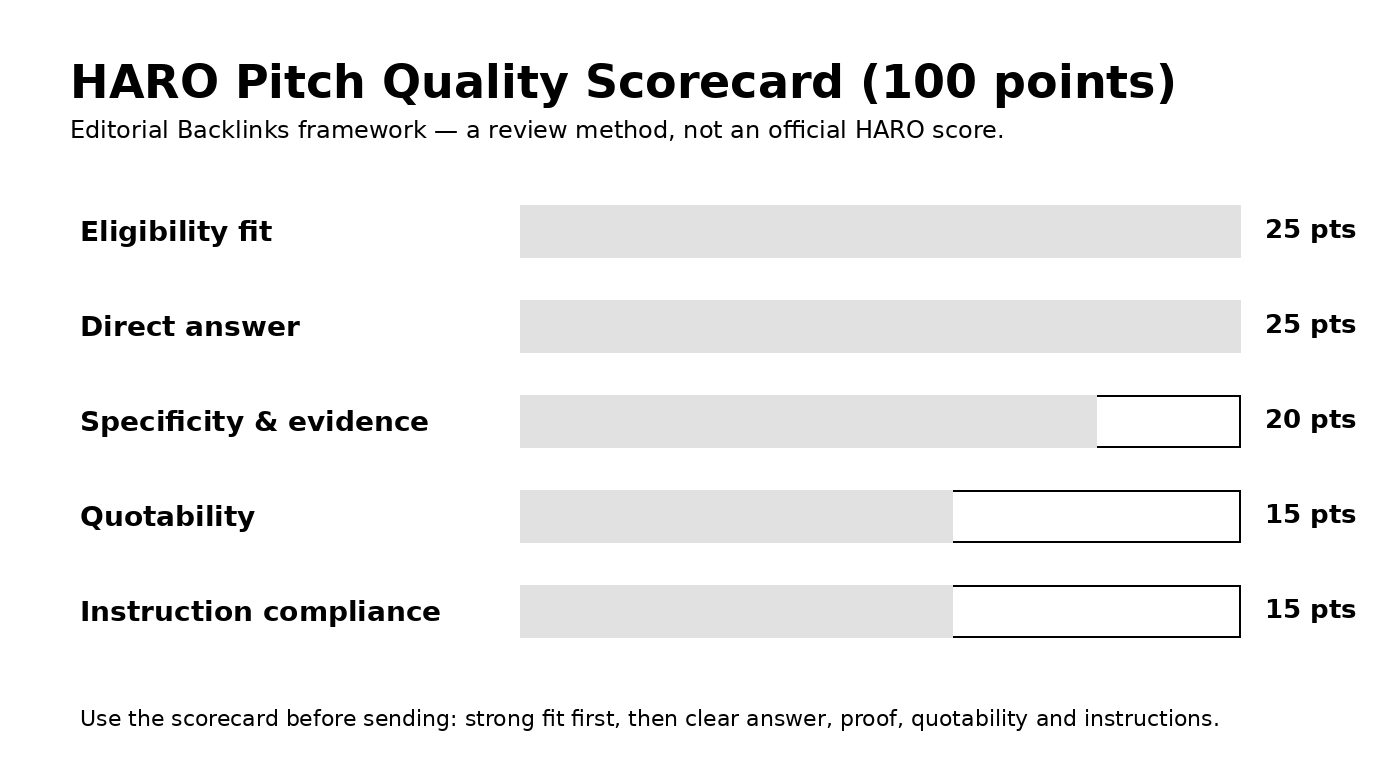
| Criterion | Weight | What earns the points |
|---|---|---|
| Eligibility fit | 25 | The expert genuinely matches the profession, geography, experience, licence or other criteria in the request. |
| Direct answer | 25 | The first useful paragraph answers the journalist’s question rather than introducing the company. |
| Specificity & evidence | 20 | The answer contains a concrete example, operational detail, verifiable number or first-hand observation. |
| Quotability | 15 | At least one sentence can stand alone with minimal editing. |
| Instruction compliance | 15 | Word count, deadline, format, disclosure and requested assets are all handled correctly. |
Simple rule: Do not try to compensate for weak eligibility with better copy. A beautifully written answer from the wrong expert is still the wrong pitch.
10 HARO pitch examples and response templates
The examples below are illustrative templates. They are not presented as pitches that earned specific publications, and the names, facts and numbers should be replaced with real, verifiable information from the source you are pitching.
1. Single-question expert advice pitch
Best for: a journalist asking one practical “what should people do?” question.
Subject: Reducing cart abandonment — ecommerce operations perspective
Hi Maya,
I’m Alex Chen, Head of Ecommerce Operations at Example Retail, where I manage checkout and retention projects.
The first thing I would check is whether the checkout creates a new decision at the final step. Unexpected shipping fees, mandatory account creation or a delivery estimate that appears too late can make a customer reconsider a purchase they had already mentally completed. I would surface total cost and delivery timing before the payment screen, then remove any field that is not essential to fulfil the order.
Attribution: Alex Chen, Head of Ecommerce Operations, Example Retail.
Why this works: the answer starts with a usable recommendation, explains the mechanism and avoids turning into a company advertisement.
2. Multi-question HARO response
Best for: queries that contain two or three separate questions.
Subject: Remote onboarding — answers from a SaaS people leader
Hi Jordan,
I’m Priya Shah, VP of People at Example SaaS, where I oversee hiring and onboarding for distributed teams.
1. What is the biggest remote-onboarding mistake?
Treating onboarding as a document handoff. A new hire can read policies alone; what they need from the company is context: who makes which decisions, how work moves between teams, and what “good” looks like in the first 30 days.
2. What should happen in week one?
Give the person one small, real piece of work with a clear owner and feedback loop. That creates useful questions early and exposes missing permissions, unclear processes or gaps in documentation before they become larger problems.
Attribution: Priya Shah, VP of People, Example SaaS.
Why this works: mirroring the journalist’s questions makes the response easy to scan and reduces editing work.
3. Founder-experience pitch
Best for: requests asking founders or business owners what happened in practice.
Subject: Founder lesson from our first senior hire
Hi Sam,
I’m Daniel Brooks, founder of ExampleCo. I made our first senior operations hire during the company’s early growth stage.
The mistake was giving someone a senior title without giving them senior decision rights. I wanted an operator who could take ownership, but I still expected every meaningful choice to come back to me. The result was slower execution and frustration on both sides. Before making the next senior hire, I wrote down which decisions the person could make without founder approval and which metrics they fully owned.
Attribution: Daniel Brooks, Founder, ExampleCo.
4. Location-specific expert pitch
Best for: requests limited to a country, state, city or local market.
Subject: Austin home-maintenance insight — local contractor
Hi Taylor,
I’m [Name], a [licensed/qualified role if true] based in Austin, Texas, working with homeowners across Central Texas.
[Direct local observation.] The important local factor is [climate, regulation, housing stock, seasonal condition or other genuinely relevant local detail]. In practice, I advise homeowners to [specific action] because [clear consequence].
Attribution: [Name], [Role], [Company], Austin, Texas.
Why this works: it proves geography immediately instead of making the reporter infer it from the company website.
5. Data-backed HARO pitch
Best for: queries requesting statistics, trends or numerical evidence.
Subject: Customer-support trend — source and methodology included
Hi Morgan,
I’m [Name], [Role] at [Company]. We track [relevant metric] across [clearly defined data set].
Our [month/year] internal analysis found [verified result]. The figure covers [sample definition] and excludes [important exclusions]. The pattern matters because [short interpretation]. I can share the underlying methodology or a non-confidential summary if useful.
Attribution: [Name], [Role], [Company].
Important: never invent a percentage because a journalist asked for data. If you cannot define the sample, period and source, use a qualitative expert observation instead.
6. Contrarian-but-defensible pitch
Best for: crowded topics where generic advice will sound identical to every other response.
Subject: Why “more meetings” is the wrong fix for remote communication
Hi Casey,
I’m [Name], [relevant leadership role] with [relevant experience].
I would not solve weak remote communication by adding another recurring meeting. The real problem is usually that decisions are being made in places nobody can find later. A better fix is to decide which discussions require a live conversation and which decisions must be written down in a durable channel. That reduces both meeting load and the “I didn’t know that changed” problem.
Attribution: [Name], [Role], [Company].
Why this works: the opening gives the journalist a clear, distinctive line while the explanation keeps it credible rather than provocative for its own sake.
7. Technical expert response
Best for: cybersecurity, software, engineering, finance operations or other technical requests.
Subject: API security — practical control for token exposure
Hi Riley,
I’m [Name], [technical role] with [relevant experience/credential].
[Direct technical answer in plain English.] The risk occurs when [mechanism]. A practical control is [specific control], because it limits [specific failure mode]. I would also verify [second control] before treating the issue as resolved.
Attribution: [Name], [Role], [Company].
Tip: define acronyms once and write for the publication’s reader, not for colleagues who already know the terminology.
8. Urgent-deadline reaction pitch
Best for: breaking news or same-day commentary where the reporter needs one concise reaction.
Subject: Reaction to [news event] — [expert role]
Hi Jamie,
I’m [Name], [Role] with direct experience in [relevant field].
The immediate implication is [one clear consequence]. The part I would watch next is [specific next signal], because that will show whether [short explanation].
Attribution: [Name], [Role], [Company].
For short-deadline opportunities, speed matters only after fit is confirmed. See our response-time guide for a practical triage system.
9. Query requesting a bio and headshot
Best for: requests where the reporter explicitly asks for attribution assets.
Subject: Expert response — [topic]
Hi Avery,
[Direct answer first, with the expert’s relevant insight.]
Short bio: [Name] is [role] at [company] with [specific relevant experience or credential]. [One sentence only if it directly supports the topic.]
Headshot: [Direct cloud or media-library link if requested.]
Website: [URL]
Why this works: requested assets are separated from the quote, so the journalist can copy the answer without removing biography text.
10. Follow-up response after a journalist replies
Best for: a journalist asking for clarification, another example or verification.
Subject: Re: [original subject]
Hi [Journalist name],
Absolutely. To clarify, [direct clarification]. The example I mentioned refers to [precise context]. [If relevant: The number comes from X and covers Y period.]
If you need a shorter version for attribution: “[one clean sentence that accurately summarizes the point].”
Best,
[Name]
Why this works: follow-up is treated as an editorial task, not another opportunity to pitch the company.
HARO pitch length: practical house guidelines
HARO queries can specify their own limits, and those instructions always override generic advice. When no limit is given, the following ranges are useful Editorial Backlinks house guidelines, not official HARO rules.
| Query type | Suggested working range | What to prioritize |
|---|---|---|
| One direct question | 80–150 words | One answer, one reason, one example |
| Two or three questions | 180–300 words | Mirror each question with a short answer |
| Personal/founder experience | 120–220 words | Specific event, decision and lesson |
| Technical explanation | 150–250 words | Plain-English mechanism plus practical control |
| Breaking-news reaction | 60–120 words | Immediate implication and what to watch next |
Weak vs strong HARO pitch: side-by-side comparison
| Element | Weak pitch | Stronger pitch |
|---|---|---|
| Opening | “Thanks for the opportunity. Our company is a leading…” | “The first thing I would check is…” |
| Credential | Long biography with unrelated achievements | One line proving the exact requested expertise |
| Answer | General advice that could apply to any topic | Specific recommendation plus reason or example |
| Company mention | Repeated product or service promotion | Used only for attribution or relevant context |
| Format | One long wall of text | Short paragraphs matching the journalist’s questions |
| Evidence | Unverifiable claims and invented statistics | First-hand experience or clearly sourced facts |
| Instructions | Ignores word count, geography or requested assets | Every requirement checked before sending |
How to write a HARO pitch step by step
- Check eligibility before writing. Confirm profession, geography, credentials, direct experience and deadline.
- Extract every question. If there are three questions, create three answer slots before drafting.
- Write the answer before the biography. The journalist’s task comes first.
- Add one proof point. Use a real example, process detail or verifiable data point.
- Create one clean quotable sentence. It should make sense even if the rest is cut.
- Remove promotional language. The pitch should sound like source material, not sales copy.
- Fact-check. Verify names, numbers, credentials, legal claims and client examples.
- Follow the request exactly. Respect word count, format, assets and deadline.
If you want a deeper explanation of rejection patterns, read why journalists reject expert pitches. If you want the full workflow from source request to live placement, see the HARO-style link-building guide.
Can you use AI to write HARO responses in 2026?
AI can help with structure, editing and clarity, but it should not be used to manufacture expertise, statistics, credentials or first-hand experience. HARO has introduced AI-likelihood scoring for journalist dashboards, and journalists can choose to filter responses flagged as likely AI-generated. If a query explicitly says “No AI responses”, do not submit an AI-written response.
That is also why our free journalist pitch generator asks for a real expert bio and includes review warnings. Treat generated text as a draft. The named source should verify every factual claim and rewrite the wording so the response accurately reflects their knowledge and voice.
When to skip a HARO request
Not every query deserves a pitch. Skip the request when the source does not meet the stated qualification, the deadline does not allow proper review, the answer would require guessing, the journalist prohibits the drafting method you intend to use, or the topic sits outside the source’s real experience.
A selective approach is more credible than responding to everything. Our HARO alternatives guide explains when Qwoted, Featured, direct journalist outreach or proactive digital PR may be a better route.
What happens after you send the pitch?
Publication is never guaranteed. The reporter may use the quote, ask for clarification, choose another source, edit the wording, publish without a link or not publish the planned article at all. That editorial control is normal.
When a placement goes live, verify the article URL, attribution, context and observed link status. Our verified placements portfolio shows how we separate original editorial placements from syndicated copies, and our 100-point backlink quality framework explains how to evaluate the resulting link rather than relying on one domain metric.
Frequently asked questions
What is the best HARO pitch template?
The best HARO pitch template is a flexible structure: brief credential fit, direct answer, supporting example or evidence, and clean attribution. The journalist’s instructions should always override a generic template.
How long should a HARO response be?
Use the shortest response that fully answers the request. When the journalist provides a word limit, follow it. Without a stated limit, a single-question response often works best as a concise answer rather than a long essay.
Should I introduce myself before answering?
Use one short line when your qualification needs to be verified immediately, but avoid a multi-paragraph company introduction. The usable answer should appear near the top.
Should I ask for a backlink in my HARO pitch?
No. Pitch the expertise, not a link demand. The publisher controls whether a source is credited, linked and how any link is treated.
Can I reuse the same HARO response template?
You can reuse the structure, but not the substantive answer. Each response should be written for the journalist’s exact question, audience, qualification criteria and requested format.
Can I use the same expert for every query?
No. Use the expert whose actual experience best matches the request. Stretching one spokesperson across unrelated topics weakens trust and increases the risk of inaccurate claims.
Does a HARO pitch guarantee a backlink?
No. A strong pitch can improve usability, but journalists and publishers retain editorial control over source selection, publication, attribution and links.
Want a draft to work from?
Paste the journalist’s request and a real expert bio into our free HARO Pitch Generator. Review every claim before sending. If you want the opportunity research, drafting, approvals and tracking handled for you, see our HARO-style journalist outreach service.
Sources and further reading
Share your site, target pages and current outreach approach for a practical campaign-fit review.